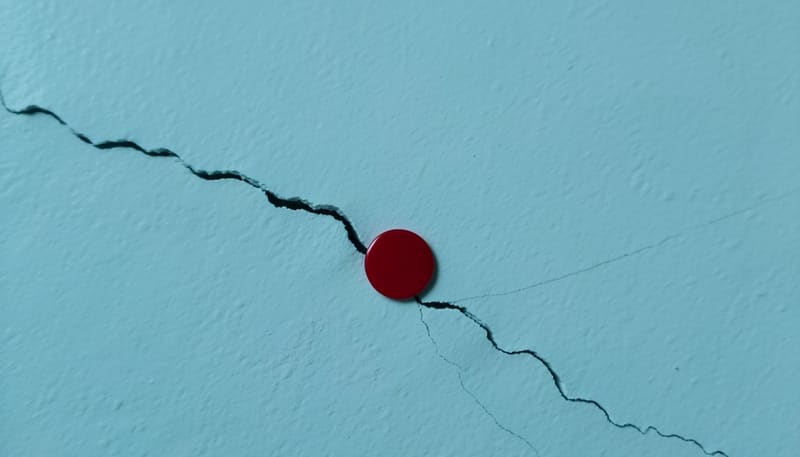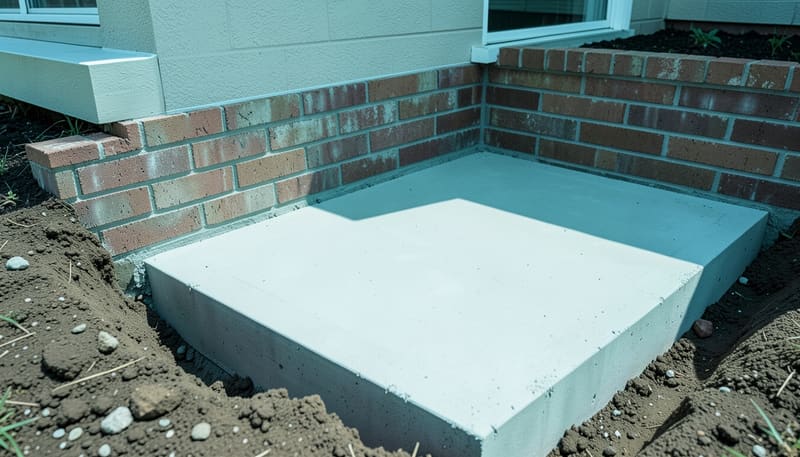
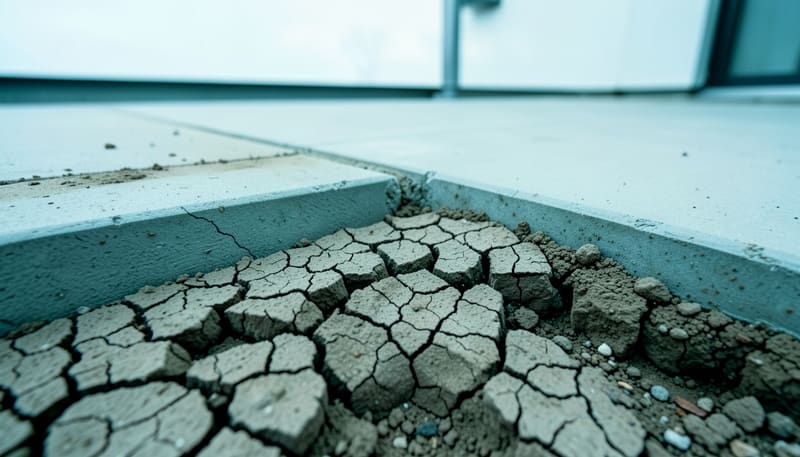
The short answer
Reactive clay swells as it gets wet and shrinks as it dries, so a concrete slab built on it can lift in some places and drop in others. Slab heave is part of the slab lifting, usually as moisture builds up beneath it; settlement is part of it sinking. Fine concrete slab cracks are common and often harmless, but cracks that widen, step out of level or come with sticking doors need an engineer.
Key takeaways
- Reactive clay swells when wet and shrinks when dry, so slabs on it move with the seasons.
- Slab heave is the slab lifting; settlement is the slab sinking. The fixes are different.
- AS 2870 site classes, from A to E plus P, rate how much a site's soil can move.
- Steady moisture around the slab, and fast leak repairs, are the first line of defence.
Many Australian houses sit on clay soils that move with the weather. Most of the time the footings cope. But when one part of the ground gets much wetter or drier than the rest, a concrete slab can lift, drop or crack, and the walls above it follow. Here's what's happening underneath, and how to tell harmless slab cracks from the ones that need an engineer.
Reactive clay and slab heave: quick facts
- Reactive clay
- Swells when wet, shrinks when dry
- Slab heave
- Part of a slab lifting as moisture builds up beneath it
- Site classes
- A, S, M, H1, H2, E and P under AS 2870
- Common in
- Many Melbourne suburbs and much of metropolitan Adelaide
- Main triggers
- Leaks, poor drainage, downpipes and trees
- Our crack report
- From $450 + GST for a typical house
What is reactive clay (reactive soil)?
Reactive soil is soil whose volume changes with its moisture content, and reactive clay is the most common kind. Clay swells as it takes up water and shrinks as it dries, so the ground under a house rises and falls through the year. Cracks on reactive clay often open and close with the seasons for the same reason.
The movement is rarely even, and that's the real problem. Soil under the middle of a slab tends to change slowly, while soil at the edges wets and dries with rain, gardens, downpipes and trees. The difference across the slab, more than the movement itself, is what bends slabs and cracks walls.
Seasons
Clay shrinks in long dry spells and swells after sustained rain, so footings rise and fall through the year.
Trees
Roots draw water from the soil, so clay near a large tree can dry and shrink more than the rest.
Leaks and drainage
Leaking pipes, downpipes and ponding soak the clay in one spot, which can make it swell or soften.
Under the slab
Moisture under the middle of a slab changes slowly, while the edges respond to the weather.
AS 2870 site classes: how reactive is your site?
AS 2870, the Australian Standard for residential slabs and footings, groups sites by how much the ground surface could move as the soil wets and dries. For reactive sites the measure is the characteristic surface movement, written ys, in millimetres. The higher the class, the more movement the footings have to cope with.
AS 2870 site classes: characteristic surface movement (mm)
- A · sand and rockMinimal
- S · slightly reactive0–20 mm
- M · moderately reactive20–40 mm
- H1 · highly reactive40–60 mm
- H2 · highly reactive60–75 mm
- E · extremely reactiveOver 75 mm
| Class | What it means | Surface movement |
|---|---|---|
| A | Most sand and rock sites, with little or no ground movement from moisture changes | Little or none |
| S | Slightly reactive clay sites | 0–20 mm |
| M | Moderately reactive clay sites | 20–40 mm |
| H1 | Highly reactive clay sites | 40–60 mm |
| H2 | Highly reactive clay sites, with more movement than H1 | 60–75 mm |
| E | Extremely reactive sites | Over 75 mm |
| P | Problem sites, such as soft soils, uncontrolled fill, trees or abnormal moisture conditions | Classed by the problem, not a range |
For a new house, the site is usually classified from a soil investigation, and the footings are designed to suit. For an existing house, the original classification may be on the building plans, and an engineer may recommend a fresh soil investigation if the house has moved.
A site class describes the soil, not the house
A house designed for its class can still move if a leak, a tree or poor drainage changes the moisture under part of it. Classes can also differ between nearby blocks, so a neighbour's soil report doesn't tell you about your site.
Reactive clay in Melbourne and Adelaide
Reactive clay is common in both cities, but soils change from suburb to suburb and sometimes between neighbouring blocks. Treat the notes below as general background: only a soil test tells you about a particular site.
Melbourne
Many Melbourne suburbs sit on reactive clay, including the clays on the basalt plains to the north and west of the city. On these soils, cracks that open and close with the seasons are a familiar pattern, and a leak or a large tree near the house can make the movement worse. See our structural engineers in Melbourne.
Adelaide
Much of metropolitan Adelaide sits on reactive clay, and many sites are classed H1, H2 or E: highly or extremely reactive. That makes moisture control around the house, prompt leak repairs and care with trees especially important. See our structural engineers in Adelaide.
Reactive clays occur in other parts of Australia too, so the same principles apply wherever you live. We inspect slabs and footings across all our service areas.
What is slab heave?
Slab heave is part of a concrete slab lifting, usually because the reactive clay under it has taken up water and swollen. Engineers describe it by where the lift is.
- Edge heave
- The edges of the slab lift relative to the middle, for example after a wet period or where water ponds against the house.
- Centre heave
- The middle of the slab sits high relative to the edges, for example when moisture builds up under the slab from a leak, or when the edges dry out and drop.
These terms describe the shape the slab has taken. The cause, and whether the slab is still moving, has to be confirmed on site, often with floor level readings and sometimes a plumbing test to rule out a leak under the slab.
Slab heave vs settlement: what's the difference?
Both crack slabs and walls, and they can look alike at first. The difference is direction, and it changes the fix.
| Sign | Slab heave | Settlement (sinking slab) |
|---|---|---|
| Direction | Part of the slab lifts | Part of the slab drops |
| Usual trigger | Clay under the slab taking up water, from a leak, ponding or a wet period | Soil under the slab compressing or softening, often in poorly compacted fill or after leaks; drying clay can also drop the edges |
| Where it shows | A hump in the floor, in the middle or along an edge | A dip or fall, often towards a corner, an edge or filled ground |
| Common signs | Internal doors binding, tiles cracking along a line, wall cracks near the high spot | Gaps under skirting boards, floors falling to one side, stepped cracks near the low spot |
| First step | Find and stop the water source, then monitor | Find out why the soil is moving: fill, water or drying |
| Underpinning? | May not help on its own while the soil is still swelling | May be an option if settlement continues after the cause is fixed |
Heave and settlement can even happen in the same house, for example when the edges dry and drop while a leak lifts the middle. That's why one level reading or one crack rarely tells the whole story. For movement across the whole house, read house subsidence and movement, and for what underpinning can and can't do, see what is underpinning?
Are concrete slab cracks serious?
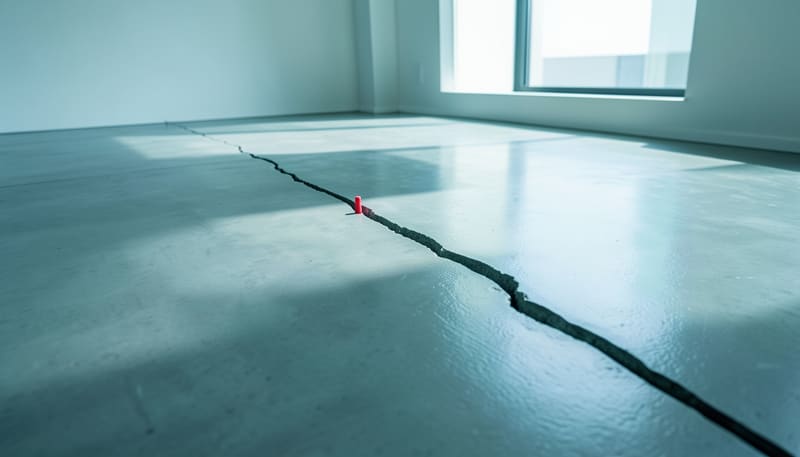
Most fine cracks in concrete slabs aren't structural. Concrete shrinks as it dries, so fine cracks are common in slabs of every age. Slab cracks matter more when they:
- Keep widening or lengthening over weeks or seasons
- Have one side higher than the other, so you can feel a step across the crack
- Crack floor tiles in a line above them
- Come with other signs, such as sticking doors, wall cracks or floors out of level
- Sit near a wet area, a known leak or a downpipe
Engineers assess slab damage separately from wall cracks, looking at crack width and how far the floor has moved out of level. Wall cracks above a moving slab are rated against the AS 2870 damage categories explained in our guide to cracks in walls.
Get a slab crack checked quickly if
It keeps widening, a hump or dip in the floor is growing, or several doors start jamming at once. A leak under a slab on reactive clay can keep feeding heave for as long as it runs.
How do you protect a slab on reactive clay?
You can't change the clay, but you can keep the moisture under and around your slab steadier. These habits do most of the work.
Do
- Fix leaking taps and pipes as soon as you notice them
- Keep downpipes connected so they discharge away from the slab
- Keep paths and garden beds falling away from the house
- Water gardens near the house moderately and evenly in long dry spells
Don't
- Let water pond against the walls or the slab edge
- Plant large trees close to the house
- Remove a large established tree without advice
- Fill a growing crack before it's been assessed
When should you call an engineer about slab cracks or heave?
- A slab crack is widening, or one side has lifted or dropped
- Doors start jamming or floors start to feel out of level
- Wall cracks appear above or beside the slab crack
- You suspect a leak under or beside the slab
- You've been quoted for underpinning, resin injection or slab jacking
- You're buying a house on reactive clay with cracked floors or walls
Find the cause before anyone quotes
Our foundation and crack report checks the slab, floors and walls, finds the likely cause and sets out your options, from $450 + GST. If the movement may be seasonal, crack monitoring shows whether it's still active. Already quoted? Start with an independent underpinning quote review.
Buying on reactive clay? A pre-purchase structural inspection checks for signs of slab and footing movement before you commit, and our guide to buying a house with foundation problems explains what to weigh up. If a newer home's slab is cracking and you're dealing with the builder, a building defect report records the damage and its likely cause.
Sources and standards referenced
- Standards Australia, AS 2870-2011 Residential slabs and footings. Site classification by characteristic surface movement (ys), and Appendix C damage categories